On the privilege of being an ocean-aware Bruny Islander
There is a particular kind of knowing that comes from living on an island shaped by the Roaring Forties, where the Southern Ocean meets the D’Entrecasteaux Channel and the sky seems bigger than anywhere else. To be a Bruny Islander is to wake each morning to the rhythm of tides, to read the weather in the shifting light on the water, to understand—in your bones—that the health of this island and the health of the sea are one and the same.
This is not a passive inheritance. It is a privilege. And privilege, in times like these, demands action.
The truth we carry
The ocean is our clearest indicator of a changing climate. It absorbs about 91% of the excess heat trapped by human-caused greenhouse gas emissions—equivalent to the heat of about 7.6 billion cups of tea being poured into the ocean every second. The rate of ocean warming has more than doubled. Sea levels are rising faster. Marine species are migrating in search of cooler waters.
We see this here. The Bruny Island bioregion has the highest level of marine endemism in Tasmania, and probably Australia—a hotspot for endemic handfishes, seastars, molluscs and algae. This extraordinary biodiversity is our gift and our responsibility. The waters around us are not just beautiful; they are irreplaceable.
And yet, we have watched as industrial aquaculture has expanded into these waters. We have seen fish pens in Storm Bay, off Bruny Island. We have smelled rotting fish carcasses washing up on our beaches. We have watched as an industry ad—promoted across Facebook and Tasmanian cinemas—was banned for making misleading environmental claims, footage from one pen presented as if it represented the whole story.
We know the difference between a promise and the truth. We live on the water. We see what the cameras don’t show.
What hope actually looks like
Hope is not a feeling. Hope is a practice. It is the quiet determination to act, even when the challenges seem overwhelming. And here on Bruny Island, that practice is already alive.
The Bruny BlueBioSphere
There is a community-led vision taking shape: the Bruny BlueBioSphere—”a community-led commitment to making the waters around our island the healthiest, most vibrant, and most deeply respected in Australia”. This is not a government program or a corporate initiative. It is us. Neighbours, fishers, families, Traditional Owners—working together to designate a network of Bruny Island Marine Sanctuaries: no-take, no-farm. A vision to protect key breeding habitats, seagrass meadows, and kelp forest refuges, in partnership with the Nuenonne community, traditionally the master marine culture of these waters.
This is hope in action.
Science we can trust
When a local tour operator saw “dead zones” in the D’Entrecasteaux Channel, he didn’t just worry—he helped fund a five-year scientific study of the waterway between Bruny Island and mainland Tasmania. This is what it means to take responsibility for what you love. It means investing in knowledge, not just opinions. It means letting the data guide us, even when the data is uncomfortable.
The ASC Standard: a floor, not a ceiling
The Aquaculture Stewardship Council (ASC) Salmon Standard provides a framework for responsible farming. It sets requirements for benthic health, water quality, biodiversity protection, escapes prevention, disease management, and social responsibility. Tassal was the first Australian salmon producer to achieve ASC certification.
But here is the hard truth: certification is a minimum, not a maximum. It is a starting point, not a destination. The ASC Standard requires farms to maintain sea lice levels below thresholds during sensitive periods, to keep escapes under 300 fish per production cycle, to limit viral disease mortality to 10% or less. These are important safeguards.
But they are not enough. They were never meant to be enough. The Standard is designed to be revised, to tighten over time, to push the industry toward genuine sustainability. And it is up to us—ocean-aware communities, informed consumers, engaged citizens—to demand that it does.
Macquarie Harbour: a model of what’s possible?
There is a story unfolding on Tasmania’s west coast that offers both caution and hope. In Macquarie Harbour, salmon farming has been linked to low oxygen levels threatening the endangered Maugean skate. The federal government has invested $18.3 million in an oxygenation program to replace the oxygen consumed by fish farming. Oxygen levels are reportedly rising.
The question is not whether we can afford to restore our oceans. The question is whether we can afford not to. The Maugean skate and the salmon industry are being asked to coexist. It is a fragile experiment, a test of whether economic activity and ecological integrity can share the same water.
The jury is still out. But the experiment is being watched—by scientists, by regulators, by communities like ours.
Concrete actions for ocean-aware Islanders
So what do we do? What does hope look like in practice?
- Know Your Standards
The ASC Salmon and Cod Standard is a public document. Read it. Understand what it requires and what it does not. Demand transparency from certified farms—they are required to publicly disclose sea lice monitoring data, escape records, mortality data, treatment records, energy use, and GHG emissions. Hold them accountable to the data.
- Support the Bruny BlueBioSphere
Get involved with BIEN. Support the vision for marine sanctuaries. Attend community meetings. Speak up for the waters you love. The Bruny Island tourism brand is not compatible with industrial aquaculture expansion. Let’s make sure our island’s future reflects our values, not just corporate balance sheets.
- Choose Wisely
Every dollar we spend is a vote for the kind of world we want. Ask your supermarket: Where does this salmon come from? Is it ASC certified? What about the feed—was it responsibly sourced? Skretting has achieved ASC Feed Certification for its Tasmanian facilities—that’s progress. But progress is not the same as arrival. Keep asking. Keep pushing.
- Connect with Traditional Owners
The Nuenonne community are the traditional custodians of these waters. Their knowledge, their culture, their connection to this place spans thousands of years. We cannot talk about the future of Bruny Island without listening to them. Support weetapoona Aboriginal Corporation. Build genuine partnerships, not token gestures.
- Demand Independent Science
The Tasmanian government has announced an independent off-island study of the salmon industry, examining environmental, social, economic and scientific aspects including climate change risks, ecosystem health, and regulatory performance. This is a step forward—but only if the study is truly independent, truly rigorous, and truly acted upon. We must ensure it is.
- Be a Voice, Not an Echo
The ad that was banned was a reminder that industry will say what it needs to say to protect its bottom line. Our job is to tell the truth. Not the polished version. Not the version that makes us comfortable. The real version: the one we see from our boats, our beaches, our windows. The one that includes both the beauty and the damage. The one that refuses to look away.
- Act Locally, Think Oceanically
The ocean doesn’t recognize borders. The PFAS found in fishmeal in Norway is a warning for feed systems everywhere. The warming that is melting Arctic sea ice is the same warming that is changing the currents that shape our coast. We are connected—to the fish, to the water, to each other. Act like it.
A final word
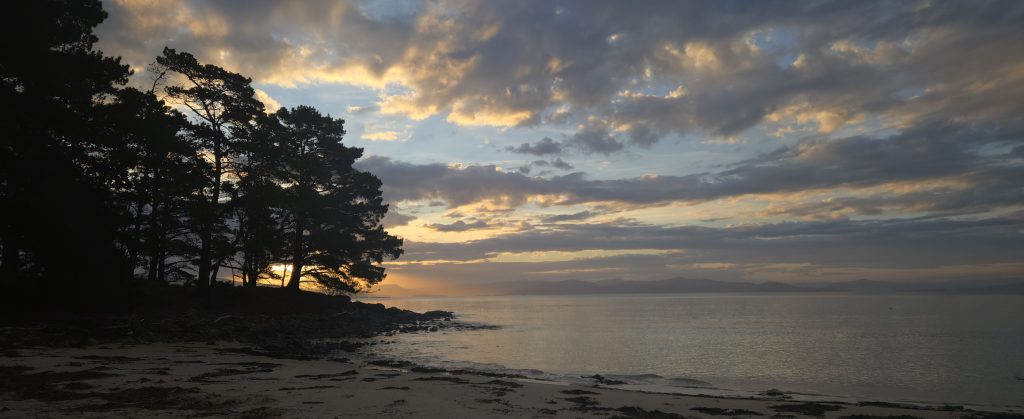
There is a story told on Bruny Island about the light. How, on certain days, the sun breaks through the clouds and the water turns to silver and the whole world feels like a promise. That light is still here. It will always be here.
But light only illuminates. It does not act. That part is up to us.
To be ocean-aware is not just to know what is happening to the sea. It is to refuse to accept it as inevitable. It is to believe—against all evidence, against all cynicism—that we can do better. That we must do better. That we are doing better, right now, in small ways that will one day add up to something large.
The privilege of being a Bruny Islander is not just the beauty that surrounds us. It is the responsibility that comes with it. The chance to be a custodian, not just a resident. The opportunity to be part of a community that refuses to let its home become a casualty of convenience.
Hope is not a feeling. It is a decision. And every day, on this island, we decide.
We decide to care. We decide to act. We decide that the future of these waters matters more than the convenience of the present.
That is hope. That is action. That is us.
The sea is not a resource. It is our mother. Act accordingly.