A blue-print for a living sea where island and sea can breathe as one again
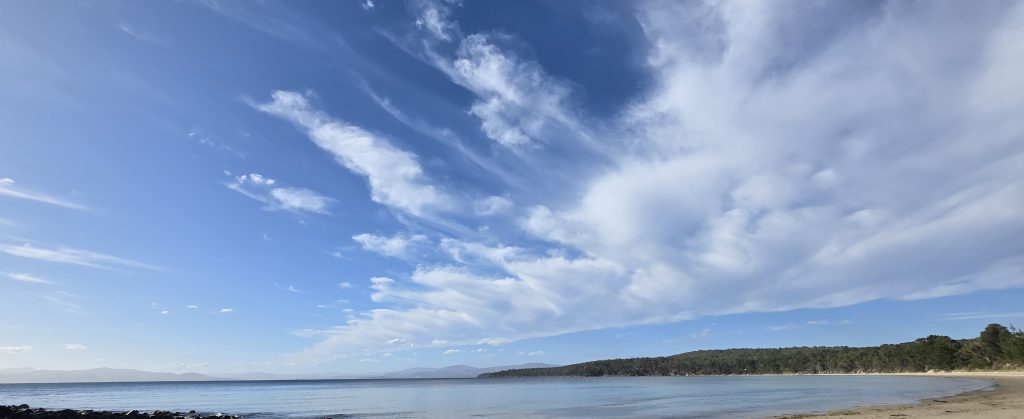
Look at Bruny Island not from the road, but from the water. From a boat in the D’Entrecasteaux Channel, the island is a long, low silhouette of Jurassic dolerite and ancient white gums, stronghold and sustenance of the island’s precious ecosystems and wildlife. From this vantage sea and sky are stitched together by the slender isthmus of The Neck, and from here we see that what truly defines Bruny is the living skin of sea that wraps it – the Derwent’s cold, dark nutrient charge meeting the Southern Ocean’s crystal worlds; the seagrass meadows that hold the carbon of millennia; the granite reefs where weedy seadragons drift. This is the island’s blue yang to its green yin: this is the pulse rolling across every beach, powering every business, and filling every story told on these shores.
Imagine a future where we live and see Bruny Island from this sea-eye view. Let’s say we call it the Bruny BlueBioSphere for now – a community-led commitment to making the waters around our island the healthiest, most vibrant, and most deeply respected in Australia. In this vision, the sea is not a backdrop or a disposal zone; it is a neighbour, a relative, a partner in everything we do.
The harbour speaks
From the perspective of the Channel, the vision appears like this: the water is clear enough that sunlight reaches the sponge gardens in Adventure Bay. The long-spined urchin barrens are retreating, pushed back by a restored army of giant rock lobsters, and by divers who harvest urchins for a new roe industry. Kelp forests sway again in cathedral light, their fronds sheltering juvenile schools of jack mackerel.
Beneath the farms and jetties, native flat oysters are building living reefs—filtering the water, buffering the waves, creating nurseries for countless species. The Maugean skate, no longer gasping in oxygen-starved Macquarie Harbour, has its future secured because we listened to the science and removed the net-pen nutrient burden.
Voices of the aquatic world
The handfish whispers: we walked these sands before your maps. You have seen our numbers shrink; now, walk with us. Help us by cleaning the waters where our eggs hatch.
The short-tailed shearwater, that winged wonder who navigates from the North Pacific to the sandy burrows of The Neck each year, calls: What you do on land and in the sea, I feel in my bones. I need pilchards and krill, not microplastics and antibiotic traces.
The abalone, whose iridescent shell has adorned necks for millennia, murmurs: I am the taste of this place. When you protect my home from the drift of chemicals, you protect your own feast and your export markets. Our fates are linked.
Measures for regeneration: a community action blue-print
To bring the Bruny BlueBioSphere to life, let us together commit to a tangible set of actions, rooted in both Indigenous knowledge and Western science, for the benefit of all who live here, work here, and visit.
- Radical transparency and real-time monitoring
Make all discharge data – nutrients, antibiotics, mortalities, net-cleaning plumes – publicly accessible in real time, not drip-fed through information access requests. Deploy a community-funded water quality sensor network, with data displayed on a public dashboard, so everyone from the oyster farmer to the weekend swimmer knows the sea’s health today.
- Nutrient budgets, not just benthic scores
Establish legally binding total maximum daily loads for nitrogen, phosphorus and organic carbon across the Channel, Storm Bay, and Macquarie Harbour, treating them as shared public resources. Regulate salmon farms on the cumulative nutrient footprint, not just the mud 35 metres from a pen. This is what Norway failed to do until its fjords began to suffocate.
- Ban preventable antibiotics, fund alternatives. Close the door permanently on open-water use of florfenicol and any antibiotic that threatens wild fisheries, human medicine, and ecosystem resilience. Redirect government support toward vaccines, selective breeding for disease resistance, and closed-containment systems that capture waste before it enters the sea.
- Waste capture and net-cleaning reform
Require all fish farms to install and operate waste collection curtains or equivalent technology to capture uneaten feed, faeces, and net-cleaning debris within the lease area. Plumes of hydroid fragments should never reach Coningham or Roaring Beach. Get the authorities and industry bodies to invest in autonomous cleaning robots that contain and collect biofouling, rather than simply scattering it.
- Marine protected areas and restoration zones
Designate a network of Bruny Island Marine Sanctuaries – no-take, no-farm zones – co-designed with the Nuenonne community, traditionally the master marine culture, to protect key breeding habitats, seagrass meadows, and kelp forest refuges. Pair them with active restoration: reseeding giant kelp, rebuilding native oyster reefs, and paying fishers and divers to remove urchins and restore balance.
- Indigenous Sea Country management
Embed Nuenonne / Palawa knowledge and custodianship in all marine planning. Support an Indigenous ranger program for Bruny’s coasts and waters, blending cultural burning of coastal heath with the management of intertidal and subtidal resources, recognising that the sea is part of a living cultural landscape.
- A BlueBioEconomy that works for locals
Foster enterprises that thrive on a healthy sea: certified sustainable wild abalone and lobster fisheries free of contamination risk; seaweed farming for food and bioplastics; eco-tourism that shows visitors the recovering kelp cathedrals and seadragon gardens; and processing of urchin roe for domestic and export markets. A percentage of every tourism dollar could flow into the BlueBioSphere Restoration Fund.
- Citizen science as a way of life
Turn every Bruny resident and regular visitor into a guardian. Simple phone apps can log algal blooms, beach debris, whale sightings, and water clarity. School groups can monitor seagrass transects. Surfers can deploy tiny sensors on their boards. The data belongs to the community, not a corporate server.
A shared future
In the Bruny BlueBioSphere, a fisher from Alonnah, a Palawa elder, a visiting family camping at Cloudy Corner, and a marine biologist all read the same water quality report on their phones and understand what it means. The salmon farmer’s pride comes not from hidden tonnages of antibiotics, but from near-zero pollution, fully traceable from egg to plate. The abalone diver smiles because the seafloor is clean, and the international buyers smile back. The shearwaters return each year in their hundreds of thousands, fat on anchovies from a reviving ocean.
This is not a distant dream. It is a choice, a choice to stop seeing the sea as something that happens to the island, and to start understanding that the island only exists because the sea embraces it. The BlueBioSphere is the yin to Bruny’s yang, the heart that pumps life into every home, every business, and every wild creature that calls this place home.
Let’s make this our shared purpose.