The ocean is under attack. Not in some distant future, not in some abstract way. but here, now, in the waters that shape this island.
The island is not a retreat. Not a place to escape the world’s problems, not another suburban subdivision creeping toward the shore. It is something rarer, something more urgent.
The island is a forward base for rescue action.
To live here is not to withdraw. It is to position yourself at the front line. It is to accept that the health of this place—the clarity of its water, the abundance of its life, the integrity of its kelp forests and seagrass meadows—is not a given. It is a daily choice, a daily practice, a daily stand.
What we stand against
Look at what the industrial model has already done.
In Norway, the country that built the global salmon boom, the fjords are paying the price. Oxygen levels in some of the most intensively farmed areas have dropped by a third since the 1950s. Harmful algae blooms—fed by nutrients from fish waste, urine, and uneaten feed—are choking kelp forests. Chemicals and heavy metals from decades of farming persist in the sediment, twenty years after sites were fallowed. The industry’s own representatives concede that the environmental limits are being tested, even as they argue about the science.
Waste from open-net pens is not contained. It directly permeates the water column, the current, and chokes the life that depends on cleanand healthy water. It acts like fertiliser—but for the wrong things. It encourages the growth of opportunistic algae that smothers the kelp, depletes oxygen, and in extreme cases, wipes out everything below.
And then there are the chemicals.
Here in Tasmania, a coalition of wild-catch fishers—the Tasmanian Rock Lobster Council, the Tasmanian Abalone Council, and the Tasmanian Commercial Divers Association—have united against the use of the antibiotic florfenicol in salmon farms. Their concern is not abstract. It is commercial and real. Many export markets have no approved maximum residue limit for florfenicol in wild-caught seafood. Even trace detections could mean rejected consignments, lost markets, and a reputation for premium Tasmanian seafood—built over generations—shattered in an instant.
The salmon industry says the antibiotic is about fish welfare. But 13,000 tonnes of fish still died this year despite its use. The industry’s own arguments undermine themselves. And the risk is not theirs alone to take. It is a risk imposed on every fisher, every diver, every community that depends on the health of these shared public waters.
Our waters are not a waste-disposal system for an industry that repeatedly seeks special treatment to overcome problems inherent in its own intensive production methods.
What we stand for – the Bruny Blue BioSphere
This is not a government program. It is not a corporate greenwashing exercise. It is a community-led commitment to making the waters around our island the healthiest, most vibrant, and most deeply respected in Australia.
We are working toward a network of Bruny Island Marine Sanctuaries: no-take, no-farm zones that protect breeding habitats, seagrass meadows, kelp forest refuges, and the irreplaceable marine life that calls this place home. We are doing this in partnership with the Nuenonne community, the traditional custodians of these waters, whose knowledge and connection to this place is not a footnote—it is the foundation.
Community, not commodity
We reject the framing of our waters as a resource to be extracted, a site of production to be maximised. We embrace our role as custodians. We insist on the precautionary principle: unless it can be demonstrated beyond doubt that an activity presents no environmental, commercial, or reputational risk, it should not proceed.
We support the wild-catch fishers who have stood up—rock lobster, abalone, commercial divers—and said, “Enough. Our livelihoods, our reputation, our shared future is not for sale.”
We support the scientists, the freedivers, the photographers who document what is happening under the surface, who refuse to let the truth be drowned out by marketing campaigns and lobby groups.
Innovation that matters
We are not anti-fish-farming. We are anti-irresponsible farming. We are anti-open-net-farming in sensitive waters. We are anti-putting profit before place.
Innovation in aquaculture is possible—the “Egg” design in Norway, closed systems that separate fish from the surrounding environment, technologies that contain waste and reduce disease transmission. These are not fantasies. They exist. They work. They cost more, because they do more to protect the public good.
If an industry cannot afford to farm responsibly, it cannot afford to farm at all.
What we will do
Act locally, think oceanically: The ocean does not recognise borders. The PFAS found in fishmeal supply chains is a warning for feed systems everywhere. The warming that melts Antarctic and Arctic sea ice is the same warming that changes the currents that shape our coast. We are connected—to the fish, to the water, to each other. Let’s act like it.
Know the standards, hold them accountable: The ASC Salmon and Cod Standard tendered recently for comment is a public document. It is not perfect. It is a floor, not a ceiling. It requires farms to monitor benthic health, maintain oxygen levels, limit escapes, report mortality, and disclose treatments. But it only works if we demand transparency and accountability. Certified farms are required to make data public. Let’s read it. Let’s use it. Let’s push for more.
Refuse the false choices: We reject the framing that it is jobs versus the environment, industry versus community. That is a false choice. The real choice is between short-term extraction and long-term stewardship. Between private profit and public good. Between an industry that adapts and an industry that demands the world adapt to it.
Be a voice, not an echo: The salmon industry has a powerful lobby, a compelling marketing machine, and a history of getting what it wants. But the ad that was banned—the one that made false environmental claims—is a reminder that industry will say what it needs to say to protect its bottom line. Our job is to tell the truth. Not the polished version. Not the version that makes us comfortable. The real version: the one we see from our boats, our beaches, our windows. The one that includes both the beauty and the damage. The one that refuses to look away.
Why this matters
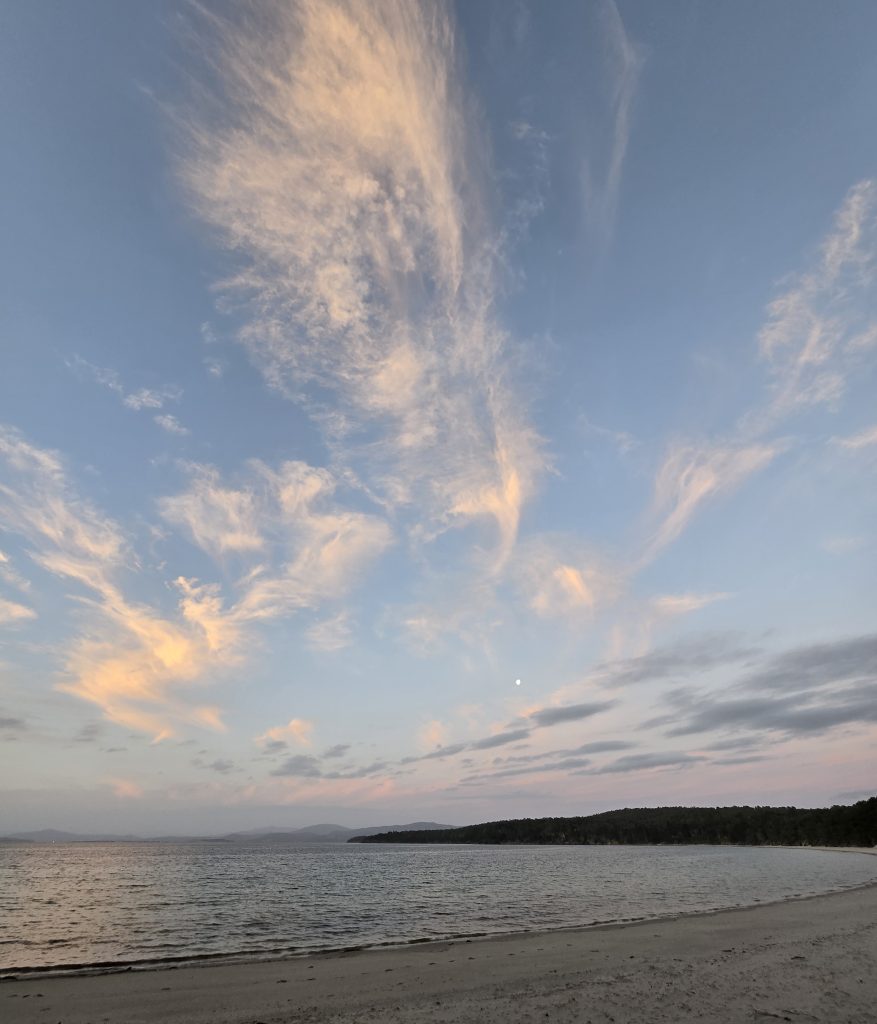
There is a story told on Bruny Island about the light. How, on certain days, the sun breaks through the clouds and the water turns to silver and the whole world feels like a promise.
That light is still here. But while it will always be here: light only illuminates. It cannot act: that part is up to us.
To be ocean-aware is not just to know what is happening to the sea. It is to refuse to accept it as inevitable. It is to believe—against all evidence, against all cynicism—that we can do better. That we must do better. That we are doing better, right now, in small ways that will one day add up to something large.
The privilege of being a Bruny Islander is not just the beauty that surrounds us. It is the responsibility that comes with it. The chance to be a custodian, not just a resident. The opportunity to be part of a community that refuses to let its home become a casualty of convenience.
The island is not a retreat. It is a forward base. And we at BIEN are already in action.
Join us. Support the Bruny BlueBiosphere. Get involved with BIEN. Speak up. Show up. The water is watching.