Bruny Island sits at the confluence of forces—the cold breath of the Southern Ocean, the dark tannin tongues of the Derwent, and the East Australian Current’s fading pulse. This mixing zone sustains one of Australia’s most biodiverse marine assemblages: handfish, weedy seadragons, abalone, and rock lobster all navigate its reefs and channels. Yet this week, the depth of that marine world has been measured in tonnes—both of antibiotics and of dead fish.
The Zuidpool Disclosure
The EPA has finally released data from one of nine leases that used florfenicol over summer: JBS (Huon) aquaculture’s Zuidpool lease in the D’Entrecasteaux Channel. The figure is 2.7 tonnes of antibiotic in two months—used across nine treatment events between November and December 2025.
Professor Mark Blaskovich of the University of Queensland called the figure “alarming” and “a huge amount of antibiotics ending up in the environment.” His concern centres on cross-resistance: florfenicol’s close relationship to the human antibiotic chloramphenicol means resistance generated in marine bacteria can transfer to pathogens affecting human health. His sobering observation: “In Australia, resistant infections actually lead to more deaths per year than car crashes.”
The data from the remaining eight leases has not been released. The EPA did not locate the information when requested under Right to Information laws. The salmon companies possess it but have declined to provide it publicly. The EPA confirms the drug was used 21 times across nine sites. A partial report notes 553 kilograms at Tassal’s Meads Creek and Stringers Cove leases—the larger picture remains obscured.
What Died, and What Was Gained
Between January and March 2026, 9,000 tonnes of salmon—approximately two million fish—died despite the antibiotic treatment. The disease Piscirickettsia salmonis drove the mortality. Last summer’s toll without florfenicol was 13,500 tonnes; the reduction, industry argues, represents a partial success. Salmon Tasmania’s CEO told reporters the industry is “still learning how to deal with the disease.”
The wild seafood industry sees a different calculus. The Tasmanian Rock Lobster Council’s Jane McGann wrote that the “entire wild-catch sector breathed a sigh of relief” when the florfenicol permit was revoked in March. Florfenicol traces in abalone and lobster, detected more than 10 kilometres from treated pens, triggered precautionary fishery closures that remain in place indefinitely.
The Net-Cleaning Dimension
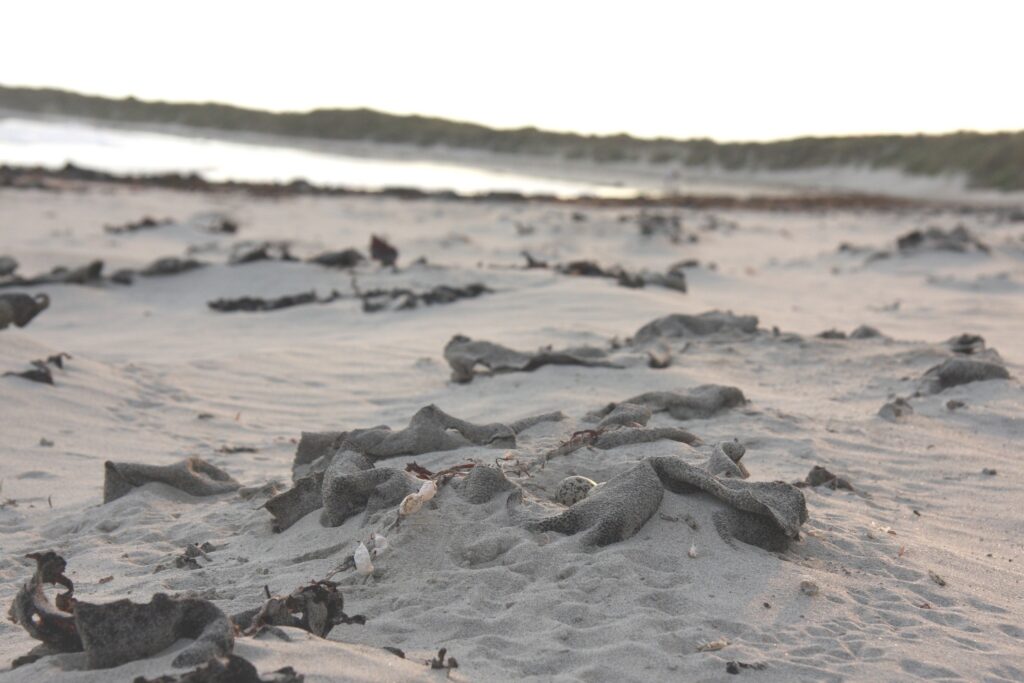
Parallel to the antibiotic story runs a quieter problem. A Norwegian study on net-cleaning debris dispersal—published in Science of the Total Environment and highlighted this week—found that high-pressure cleaning of salmon nets produces plumes of pulverised biofouling organisms that can travel up to 5 kilometres from source pens.
These biofouling communities include hydroids, which possess stinging cells capable of causing skin irritation and inflammation in humans, and severe gill injury in fish. Cleaning protocols direct plumes “downstream” to avoid drifting into adjacent pens, but the Norwegian modelling shows dispersal beyond farm boundaries is substantial.
This has particular relevance for southern Tasmanian swimmers and beach users. Beaches such as Coningham and Roaring Beach lie approximately 2.5 kilometres from active salmon leases—well within the modelled dispersal radius. While Norway’s fjord-dominated coastline may have obscured the human recreational dimension, Tasmania’s accessible beaches bring this into sharp relief. The increasing deployment of autonomous underwater cleaning robots—which can operate continuously, unlike divers—suggests this source of marine debris may intensify.
The Employment Picture
Amid the environmental data comes employment information. The three major salmon companies—JBS (ex-Tassal), Cooke (ex-Huon Aquaculture), and SeaLord Group Ltd (ex-Petuna)—employed 1,840 permanent staff and 513 casual workers in the final quarter of 2025. The trajectory is notable: casual employment has grown substantially from earlier years, while JBS’s permanent workforce has marginally declined. Across the three companies, casualisation is increasing. This pattern matters for Bruny Island communities: the industry’s social license partly rests on stable local employment, and a shift toward casual labour may alter that compact.
What We Are Watching
Three developments demand attention in the weeks ahead:
1. The remaining lease data. Eight sites worth of florfenicol tonnage remains undisclosed. The APVMA has confirmed it holds the information. Public release is overdue.
2. The fishery reopening timeline. Precautionary closures of abalone zones in south-eastern waters have been extended indefinitely. The monitoring program will determine when—and whether—the wild catch sector can resume full operations.
3. The next steps on antibiotics. Industry statements indicate salmon companies may seek a new permitting pathway for florfenicol. The Greens, wild fishers, and antimicrobial resistance experts have signalled strong opposition.
What You Can Do
· Stay informed. The EPA’s monitoring reports are being released incrementally. We will continue to track and share them.
· Engage with your representatives. State and federal members need to hear that transparency around antibiotic use in public waterways is non-negotiable.
· Report observations. If you swim, dive, or fish in the Channel or Storm Bay and encounter unusual debris, bloom events, or wildlife, document and share with BIEN—community observations complement the formal monitoring that remains incomplete.
· Support wild fisheries. Buying local abalone and rock lobster, when fisheries are open, sustains the sector most directly affected by antibiotic contamination.
Bruny Island’s marine world remains one of extraordinary richness. The choice before us is whether we treat the Channel as a place where transparency, precaution, and public access are the rule—or as a place where industrial operators may withhold the data that communities need to understand what is entering the waters they share.
Compiled from ABC News reporting, EPA disclosures, University of Queensland expert commentary, Tasmanian Greens media releases, Science of the Total Environment research (Vol. 954, 2024), and industry employment data.